

All of Entebbe International Airport, it seemed, was pulsing with excitement. The people who were to escort the objects from the runway whipped up and down on their feet. Officials from the Ministry of Tourism, Wildlife and Antiquities checked their phones, hastily tapping away at their screens. Not since 1971, when the body of Kabaka Edward Muteesa II was returned to Uganda, had Entebbe been gripped by such anticipation.
This was June 8 of last year. Thirty-two cultural artifacts arrived at Entebbe International Airport in Uganda. Originally taken from ethnic regions across Uganda, including the kingdoms or chiefdoms of Buganda, Ankole, Teso and Acholi, these objects included shields, spears, drums, headdresses, pottery, and other items used in traditional spiritual practices. Many of these objects had been taken by the British colonial missionary John Roscoe in the early 20th century, and Roscoe later had donated them to the University of Cambridge’s Museum of Archaeology and Anthropology. Now, over a century later, the objects had finally returned home from Cambridge.
The word taken, of course, is a euphemism for brutal pillaging in the form of theft or confiscation by Roscoe and others, as part of British colonial conquest in Uganda. The east African country became a protectorate of Britain in 1894, initiating seventy decades of white supremacy, institutionalized racism, and colonial violence. The theft of cultural artifacts is a part of this brutality. Even though some items were purchased by Roscoe, or gifted to him by individuals or communities across Uganda, this does not negate the violence inherent in these transactions, given the imbalance of power between white and Black people imposed by colonialism. The 32 objects are just a fraction of over 1,500 artifacts from Uganda held by the University of Cambridge.
The artifacts were greeted with fanfare and excitement not just at the airport but also in Kampala, the capital. Their return marked the highlight of a restitution project, ongoing since 2019, between the Uganda Museum and Cambridge. With funding provided by the Andrew W. Mellon Foundation – $100,000, to be exact, a meagre sum for a repatriation project of this nature – the project’s principal investigator is Prof. Derek Peterson of the University of Michigan. A private viewing of the artifacts was organized for President Yoweri Museveni, a press conference was held, and there was a seminar at Makerere University’s Department of History and Archaeology. By all accounts a successful return.
Three months later, on September 9, Ugandan officials and the Catholic Church welcomed more objects, this time in the form of the relics of two Uganda Martyrs, Karoli Lwanga and Mathias Mulumba, the first Black saints in modern history. The two men were killed in 1885 and 1886 respectively, and their bones were placed in a box and buried by the White Fathers. During the religious wars of the late 20th century, the church of the White Fathers was destroyed and the box was presumed lost forever. The box was subsequently sent for safekeeping in Tanganyika, where it was found and returned to Uganda in 1899. In 1942 two Catholic sisters were miraculously healed with the aid of these relics, whereupon Lwanga and Mulumba were canonized by the Catholic Church and their remains shipped to the Vatican.
The relics were returned as part of a collaborative project between the University of Michigan, Uganda Martyrs University, the Catholic Archdiocese of Kampala, and private individuals. The relics had not been stolen from Uganda, unlike the cultural artifacts; they had been given to the Vatican as part of the canonization of Lwanga and Mulumba. Their return was marked with an exhibition at Uganda Martyrs University of these relics, photographs and historical sources associated with the martyrs. This was a momentous occasion for Uganda’s Catholic community.
*
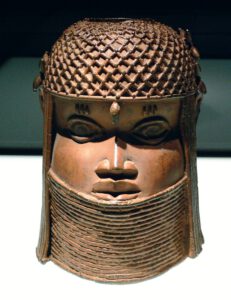
The two events are part of a growing movement to return to their countries of origin those African cultural objects that were looted or stolen during European colonialism. Perhaps the best-known case involves the Benin Bronzes, which were taken by British troops in a punitive expedition into Benin City in present-day Nigeria in February 1897. The Bronzes are now spread across 161 institutions in the Global North, including the British Museum and Pitt Rivers Museum at the University of Oxford, the Metropolitan Museum of Art and Yale University Art Gallery in the United States, the Ethnologisches Museum in Berlin, and the Musée du quai Branly in Paris. Only nine institutions in Nigeria house some Bronzes.
Across Africa, around the continent of 54 countries, European explorers, missionaries, researchers and officials took culturally valuable artifacts from different communities. In his work The Brutish Museums: The Benin Bronzes, Colonial Violence and Cultural Restitution, Dan Hicks posits the different methods of acquisition utilized by Europeans: violent looting, anthropological collection of human remains, confiscation of religious objects by missionaries and others, archaeological raiding, collection of natural history specimens for ‘scientific’ study, collection for ethnographic ‘study,’ purchase, commissioning and barter. By all accounts this is not an exclusive list, and for all forms of acquisition, as Felwine Sarr and Bénédicte Savoy wrote in a 2018 report, an element of violence and duress, whether physical or not, was involved.
The act of display in museums itself is a further instance of colonial violence, as Hicks argues. As institutions that proudly displayed the spoils of looting and acquisition in the name of European colonialism, they not only contributed to racialized pseudoscience but also became “a technology for performing white supremacy used to try to justify ultraviolence, democide, the destruction of cultural property, and the casting of sacred and royal objects to the open market,” according to Hicks.
African communities have been lobbying for the return of their stolen property since the countries gained independence in the last century. In November 1961, for example, Cambridge received a letter from Abubakar K. Mayanja, Buganda Kingdom’s minister of education, who lobbied for the return of the relics of Kibuuka, the 18th century Muganda war god. He argued that the return would be significant, in light of Uganda’s impending independence, and that the new country would be able to house the relics in its national museum. In July 1962, four months before Uganda’s independence, Cambridge returned the requested items.
The 21st century has seen more agitation by Africans for the return of such objects. Social media has helped, putting pressure on Western museums and governments to act. In 2018, in an effort to improve relations with Francophone Africa, French President Emmanuel Macron commissioned a report to investigate the presence of stolen cultural artifacts in French museums and the possibility of their return. The subsequent Report on the Restitution of African Cultural Heritage explores the history of these objects and the continued impact of colonialism on the French museum sector. It discusses in detail the meaning of restitution to modern France and Africa, and proposes a timeline, action plan and legal framework for the return of cultural artifacts held in France. Ultimately, the report argues that a successful restitution “allows for the possibility of writing a new page of a shared and peaceful history, where each protagonist can provide [their] piece of the common story.”
In 2023 Cambridge commissioned an investigation into the presence of items from Africa across its eight museums and Botanic Garden, most of which were acquired in the colonial period. This intellectual labor was undertaken by Dr. Eva Namusoke, senior curator of the African Collections Futures at Cambridge’s Fitzwilliam Museum. Her report presents more than 350,000 artifacts from Africa held by Cambridge, and they include anthropological and archaeological items, as well as plant, fossil, animal and rock specimens. Uganda is one of the countries with the highest numerical representation, along with Nigeria, Ghana, Egypt, Kenya and South Africa. Namusoke’s report recommends that, in dealing with these collections, African people ought to be centred in areas of research, documentation, teaching, hiring, collaborations, and public access to collections.
Since 2020 some museums have begun to make a concerted effort to interrogate their problematic collections. In 2021 the Musée du Quai Branly in Paris returned 26 cultural objects to Benin; in 2022 the Democratic Republic of Congo received a catalogue of 84,000 items, looted from the region by colonial power Belgium, that had been in the collection of the Royal Museum for Central Africa in Tervuren; and in the same year Germany returned 20 objects that were looted from the Kingdom of Benin and distributed around German museums and galleries for a century. These returns, however, are a drop in the ocean in comparison to all the African objects and art that remain in collections around the Global North. Such actions, ostensibly to signify commitment to anti-racism and more equitable social power structures, can be seen as little more than virtue signalling. Many institutions are reluctant to return these items, asserting the universality of art and culture – that it belongs to humankind everywhere and could be housed anywhere. Others cover their racism with a transparent veneer, expressing their doubts about the capacity of African institutions to look after the objects in the event they were returned.
It generally seems that the conditions of return continue to be dictated by the Global North. In a 2022 report by Open Restitution Africa and Africa No Filter, it was found that Africans remain excluded from the discourse on restitution, which is dominated by concerns not immediately relevant to Africans. However, such is the powerful imagination of restitution in Black popular culture that it even featured in one of the highest-grossing Marvel Universe films: we all remember the scene in Black Panther in which Killmonger takes a hammer made of vibranium, this tool once the property of Wakanda Kingdom, from the fictional Museum of Great Britain.
Returns to Africa also hinge on legislation and official bureaucracy: repatriation signifies the permanent return of an object to its country of origin, while restitution means returning it to its original owners. Both are bureaucratically challenging to achieve, and most institutions circumvent this through loaning their objects to the African countries in question. As Namusoke argues, “loans of this kind mean that the lending institution retains ownership of the [artifacts] while it is the borrowing institution that has responsibility for maintaining standards of safety and security of objects.” Of course, a loan also absolves institutions in the Global North from any real accountability over why these objects were in their possession in the first place.
The return to Uganda of the 32 objects from Cambridge was, in fact, a loan. Although the items are now in care of the Uganda Museum, they still belong to Cambridge. It is a legal and social minefield to navigate, not least because the kingdoms and communities from which the objects were taken have a right to keep them that’s at least equal to any claim by the Uganda Museum. However, as Cambridge still retains ownership, it raises the question of how much freedom the Uganda Museum has in determining what to do with the objects. One may recall the ruffling of German-Nigerian diplomatic ties in 2023 when, after a return to Nigeria of 22 artifacts from Germany, then-President Muhammadu Buhari shocked German institutions by stating that these artifacts would be given to the private ownership of the Oba of Benin. The resultant outcry was such that the German Federal Foreign Office became involved, the noise further emphasizing the right of the sovereign state of Nigeria to decide what to do with the returned artifacts. European institutions have a strong sense of ownership, one that persists even after the objects have been returned to their places of origin. One wonders how much agency the Uganda Museum has over the objects now in its care, and how far the institutional generosity of Cambridge would, or should, stretch.
*
Where does this leave the Uganda Museum? And what next for the artifacts that are now in its custody? There is no doubt that the physical return – or loaning – of these objects was a unique moment in Uganda’s national history. They had been taken from different regions and kingdoms before the creation of what is now the Republic of Uganda, and returned home to an entirely different socio-cultural and political context. Uganda recently celebrated 62 years of independence. The question now is how to position these objects and relics in relation to Uganda as a nation-state. Also, to whom do they belong now?
Uganda has a troubled relationship with its own past. Its public history and reckoning with the brutal post-colonial regimes of Milton Obote and Idi Amin remain patchy at best. State narratives romanticise a utopian pre-colonial past, demonize colonialism and proceed to centre a narrative of progress after 1986. A veil of silence is cast over the period between independence in 1962 and the victory of Museveni’s National Resistance Army in 1986. Beyond a few statues littered across Kampala, there are few efforts to publicly memorialize the atrocities committed during the regimes of Obote and Amin. However, with the Liberation Day associated with the present political regime in Kampala, celebrated with a bank holiday on January 26, the state vociferously presents modern Uganda as beginning in 1986.
In a country with such a fraught relationship with its recent past, how, then, should repatriated items be received? As already noted, there was a positive response to the return of the items from Cambridge and those that came from the Vatican. The attention from politicians and government officials brought a significant amount of coverage by the press, and the seminar at Makerere University meant that undergraduate students could learn more about the returned items. Still, a veil of exclusivity remained: beyond museum professionals from both Cambridge and Uganda, academics involved in the project, traditional conservators, government officials and some journalists, virtually no one from the general public was able to view the objects.
In a bid to counteract this exclusivity, after the return of the items Namusoke and I hosted a panel discussion, to which culture, art and history enthusiasts in Kampala were invited for the opportunity to talk about the return of these items. A lively event held at 32 Degrees East creative centre in Kampala, it was attended by individuals with different professional backgrounds, including artists, librarians, lawyers, journalists and cultural practitioners. Namusoke’s presentation, and the energetic discussion that followed, proved that there is a thirst for discourse on history, culture and identity in Uganda beyond the confines of academia.
The biggest question that emerged from that evening concerned the matter of where the objects were to be housed, now that they were back in Uganda. Some questioned the capacity of the Uganda Museum, where they are presently stored, to house and care for the items. Others argued that the items should be returned to the kingdoms and communities from which they had been taken, if those communities are able to look after and use the items appropriately. The Uganda Museum, founded in 1908, was built by the British, and it was felt by some in the audience that evening that putting the items in such a building made no sense.
In any event, discourse on this matter remains moot for the time being, as the Uganda Museum remains closed for renovations for a year. An exhibition featuring the objects returned from Cambridge is planned for when the institution reopens in 2026, to be curated by Peterson, Uganda Museum curator Nelson Abiti, and others. What will happen after the exhibition is entirely unknown. While an exhibition is an important element of public history, the fact remains that the museum itself is only accessible to a small minority in Kampala and Uganda. It also must be acknowledged that it is located in the geographical borders of Buganda Kingdom, as it were, while at the same time holding cultural objects specific to kingdoms elsewhere in Uganda.
There is now an opportunity to collaborate with communities around the country and to take the discourse on restitution outside of the ivory tower. In the report on Cambridge’s African Collections Futures, Namusoke recommends collaborating with artists to facilitate engagement with collections. Uganda’s arts and culture scene is thriving, and, if the conversation at 32 Degrees East is anything to go by, artists would love the opportunity to engage not only with the objects but also with the communities from which they were taken. The return of these items presents an opportunity for educators and historians within and outside of academia to initiate projects that educate and inspire different communities in Uganda.
Ore Disu, the director of the newly established Museum of West African Art (MOWAA), which will open this year in the Nigerian state of Edo, stated in an interview with The Republic that the discourse on restitution should focus less on Western institutions and more on the communities that were affected by the colonial theft. The MOWAA, she said, adopts an expanded, future-facing definition about repatriation,” one that “provides skills and opportunities for the descendants of the artists, artisans and families impacted by the loss of these works and the broader actions imperial Europe took.” This is something that can be done in Uganda, and training programs for curators, archivists, conservators or artists can use the return – and presentation – of such items in their education of the next generation of cultural professionals.
One would love to see an element of pan-Africanism in this approach to public history, in a further bid to de-centre Western institutions and to see more exchange between the Uganda Museum and other institutions around Africa. As other communities and institutions on the continent receive items, this would be an opportunity to collaborate on topics around housing, training, exhibiting and community engagement. The possibilities for Uganda to meaningfully engage with its cultural heritage are endless. To a large degree, it is up to us to decide what happens next.▪
Cover image: Mujjaguzo, a Buganda royal drum decorated with cowrie shells and triangular designs in red and black glass beads. The item was among those returned to Uganda from the University of Cambridge in June 2024.