

1.
It was not immediately clear, at the Bercy bus station in Paris, that the man in dark glasses who walked into the waiting area was really blind. He had a white cane that guided him forward and sideways, but the hauteur in his manner was not what one expected in a man without vision. He went straight for the nearest seat he could find, removing his rucksack from his shoulder so that he could rest comfortably in a metallic chair next to a Parisian couple who sat eating chocolate muffins, and across from an Arab woman in her abaya. The blind man began to shout questions in French, apparently asking why nobody had come to inquire into where he was going, and the Arab woman was the first to react. She asked him if he had a ticket, a copy of which he had in his hand, and then she went to look for a steward who could advise better. But the blind man did not know that his interlocutor had briefly stepped away, and his persistently shouted questions now got the attention of the Parisian couple. When the couple offered the blind man some of their snack, the woman drawing closer so that perhaps the blind man could get a whiff of her chocolate muffins, he smiled a contemptuous smile, the black skin of his cheeks rising in uneven ridges. The blind man took some of the muffins anyway and, speaking to the couple as if he knew who they were, said he only wanted something to drink. What happened next was hardly believable: when he heard the woman’s retreating steps, he asked how she was going to pay for his Coca-Cola and quickly drew a coin from his jacket. He was going to pay for his drink. The woman came back minutes later with the drink and the change, which the blind man felt in his palm as if he expected nothing less.
I had come to Paris by way of Antwerp, to which I was returning after spending three days in the City of Light. My time there had seemed to go quickly despite my satisfaction over what I had been able to accomplish in such little time, and in my seat at the Bercy station I was already looking forward to flying back to Uganda the next day. One of the things I wanted to do as soon as I got back home was to visit the shop in Kampala that had been slow in framing an oil painting I had recently acquired directly from the artist George William Kyeyune. They should have finished the framing work days before I flew to Belgium, which had been my wish, and now, while I wasn’t anywhere nearby, they were telling me by WhatsApp that the painting was ready to be collected.
The vague sense of urgency rising in me was now being sharpened by the sight before me of a blind man responding to those around him not with anxiety but with a sense of calm that I thought would confound any painter who tried to capture the scene. He was the most assured blind person I had ever seen, looking even more so when he spat out bits of food, but I wondered whether his outward confidence reflected inner strength or masked the unspeakable terror of eternal darkness.
It was not a failure of imagination to think of Kyeyune’s work the more I caught glimpses of the blind man, who soon went to sleep in his seat. I wondered how Kyeyune, a Ugandan artist who makes vivid pictures of life, would render blindness. He would be faithful, as he has always been, to this very personal reality, but still: how is it possible to paint a blind man who in some ways does not behave like one? It was with a great sense of reverence for Kyeyune that I concluded, still observing the blind man until finally he rose and went to board a bus, that to the extent that everything is possible in art, to the degree that Kyeyune has made images of everyday life that no other expressionist of our time has matched, he is first among those I would trust to make the image of a blind person who can see.
The oil painting that I had acquired from Kyeyune is the portrait of a Ugandan woman he created in 2021. For months it had been displayed in his office at Makerere University, where he has taught sculpture and art history since 1990, among other works that he painted in the harsh time of COVID-19. He had taken advantage of the lockdowns to make a number of new paintings, but most of them had never been exhibited and, in his office, were gathering dust by the start of 2024. The portrait of which I speak depicts a Ugandan woman who was photographed near a Kampala market scene, and, because the dress she’s wearing seems glued to her skin in the painting by Kyeyune, one suspects that it had rained on her that day. And yet, despite the bad weather, this woman’s female dignity remains intact.
In my mind there was no doubt about the importance of this untitled portrait of a Ugandan woman, and, while from the beginning I was determined to own it, for financial reasons I did not make my move until mid-year. Some days I was tormented by the thought that a random collector, chancing his way into Kyeyune’s office, would offer him such a large sum of money for the painting that he would immediately give it up, and that, if such a thing happened, I would never be able to see that piece again. One day in his studio I told him this painting was among the very best Kyeyunes I had ever seen, a personal favorite if ever I faced the terrible choice of hoarding just one of his many masterpieces. I told him why I especially liked this painting – that, looking at the canvas, I saw in the woman’s carriage what people meant when they spoke of Mother Nature. I proclaimed its singular beauty, its powerful representation of the female figure in a way that transcended physical degradation. Later, after I had paid for the painting but before I took it to the framers, I spoke to Kyeyune again of Mother Nature while I held the piece, asking whether that could in fact be the title by which the painting shall forever be known. Kyeyune should have told me that I had no right to make such a claim, but he smiled and said nothing because, despite his status as a great artist of our time, he is totally without ego.
2.
Back in 2005, when I was a cub reporter for the Daily Monitor newspaper in Kampala, to get going I had to write art reviews. If I remember correctly, only two of us were doing this work. I covered shows by the likes of Ronex and Henry Mzili Mujunga, not so much with intelligence as much as passion and a desire to get the work done. The other day I tried to search for clippings of my work to see if I ever wrote anything about Kyeyune. I was almost certain there was nothing in two years’ worth of art reviews, and yet I persisted in the spirit of discovery: what if, I now thought, I had ever encountered a Kyeyune canvas but just could not remember the event, for one reason or the other. But there was, as I had suspected, nothing about Kyeyune. Then, as now, he rarely gets a show, and when his paintings are exhibited it is not with the fanfare and publicity he deserves.
I discovered Kyeyune not so long ago, in June 2023. Xenson’s Art Space had put on a brief exhibition of the art collection of the recently departed Klaus Holderbaum, a former German diplomat who had spent his last years in Uganda. Holderbaum, who had retired from diplomatic service in 2003 at the end of his tenure as the German ambassador to Uganda, had achieved notoriety as a bon vivant with a partying lifestyle rare among diplomats of his standing, and the paparazzi had nicknamed him “Klaus Holdthebum” because some nights in Kampala the tall ambassador was to be found in a club, drink in hand, gallivanting with beautiful women. Whether Holderbaum had always been so adventurous, or had eventually succumbed to Uganda’s unique pleasures the longer he stayed here, I don’t know. In any event, he also happened to have always been a devoted patron of the visual arts wherever his government posted him, as his collection showed: notably, the artworks he acquired in Uganda included pieces by Maria Naita, Geoffrey Mukasa, Fred Mutebi, and Fabian Mpagi. Those artists are, each of them, dead or alive, highly regarded, and when I went to Xenson’s Art Space that afternoon I saw that many viewers gravitated to works by those artists.

I was instead drawn to an oil painting by Kyeyune that I thought was the bedrock piece of the Holderbaum Collection. Kyeyune made the painting, titled Circumcision, in 2007, as, I later came to learn, part of a wider series on the practice. In the piece acquired by Holderbaum a woman with impossibly long coiffured hair (wrapped in a multi-colored cloth à la Matisse) restrains another woman who faces a man armed with a knife. We can’t see what’s in the face of the woman whose genitals are about to be tampered with, even though we must assume she’s anguished or terrified, which is partly why she must be held back by the woman squatting behind her. Yet for me the painting’s point of equilibrium is not the hand that holds the knife but the man’s eyes peering into the woman’s groin. He seems to be hesitating, as if he is slowly coming back to his senses and giving himself up to nature. It’s as if Kyeyune, as he made the painting, had been shouting, You fool, what do you think you are doing? I think it’s significant that the man’s offensive hand is painted some distance from the woman’s leg. Now, someone said to me recently that the picture is not faithful to a key fact: that in societies that cut their females it’s the women who wield the knives. The point is valid, but it hardly matters if one views the painting with an open mind. After all, is it not in the selfish interest of men, for their peace of mind if not their overall sense of enjoyment, that the women are sacrificed? This is a painting that gets high marks for storytelling and for the vibrancy of Kyeyune’s palette, to say nothing of his exemplary draughtsmanship. I desired the painting with all of my heart, but acquisition was farthest from my mind.
When Xenson’s Art Space put up the Holderbaum Collection for view, it was intended only as a days-long show. The organizers pointed out that the works were not for sale although they might come up for auction after the estate had organized itself and valued the works. I forgot about the painting, but weeks later, in September, I returned to the gallery on some other business and was about to take leave of the receptionist when it occurred to me to ask about the Holderbaum Collection. It had been dispersed, the young woman said, with some pieces taken to Nairobi for the annual East Africa Art Action. Not surprisingly, the Kyeyune had been left behind and was for sale. “Could I see it please?” I asked the woman, my pulse quickening as she went upstairs to fetch it not from the wall upon which I thought it hang but among many artworks piled up in a room behind a curtain. (Later, after I told Kyeyune how I acquired his painting in the most bizarre of circumstances, he smiled an unassuming smile, and he didn’t even ask how much I paid for his work, which wasn’t much for such a rare painting).
It seems the valuers of the Holderbaum Collection hadn’t thought much of Circumcision, much to my advantage, and when an amount was stated I declared my intention to purchase the painting. I would pay for it in two monthly instalments, I promised, and indicated that I was to return the next day with the first instalment. But that night I was hit by an episode of paranoia – precisely, if I am honest, by the thought that the gallerist, later coming to her senses and realizing that the piece by Kyeyune was worth much more, would renege on our agreement. The thought came to me with urgency. I determined that I was to pay the full amount immediately and take the painting with me, which is what I did the morning after. I was barely in time. After I made the payment, the receptionist carried the painting downstairs and set it against the wall, and I squatted to examine my property. I was in this way engrossed when Xenson, the artist who owns the gallery, came rushing down the stairs to inform me that he had also hoped to acquire the painting. He said he had simply not been quick enough to make his move, even though the work had been right there in his space, and he seemed regretful that the painting had been sold at an unfortunately discounted price. It was the gallerist’s mistake, he said, conceding after a long chat that “today is your lucky day.” It was my lucky day indeed, and afterwards I entertained the notion that the most important artworks tend to go into the collections of those who deserve them. That’s not always the case, but I like to think that this painting ended up in my collection for a reason altogether more fundamental than I can attempt to explain here. It hangs in my house now, illuminated at night by the warm yellow gleam of a spotlight and its beauty strangely enhanced by the mugavu bookcase below it. My visitors, when they pass through the corridor, gaze at the painting with quizzical eyes and then quicken past it if they think they are being watched. My young children stopped trying to make sense of the painting, but one day they will figure it out. They know it’s by Kyeyune because he signed the canvas, because I often talk about Kyeyune’s work, and because they have come to recognize his work by the thick layers of paint. Some days, when I am especially possessed by the love of art, I yell at them in dramatic gesture as I step out of nowhere like a Roman conspirator to ask the question they have already had to answer so many times in their fledgling lives:

“Boys, who is Uganda’s greatest living artist?”
“Kyeyune,” they chorus. “George William Kyeyune.”
3.
Kyeyune, who is 62, graduated in 1985 from Makerere University with a bachelor’s degree in art. He started teaching at the Margaret Trowell School of Industrial and Fine Art after earning his Master of Fine Arts degree in sculpture from an Indian university. Later, in 1999, he earned a doctorate in art history from SOAS, University of London. Sculpture is Kyeyune’s forte and sculpture, not painting, is what he teaches at Makerere University. Public works he created or co-designed include The Stride, a copper monument to the 2007 Commonwealth summit in Kampala. Thus, if it’s true, as the Bible says, that men shall be known by the fruits of their labor, Kyeyune’s work speaks for itself. But his legacy will not stand upon his works of sculpture, as good as they are, for he is so outstanding as a painter that one wonders what he would have been able to create had he not been a teacher, with the comfort and security that follow him, but strictly a painter who, like many others, depended only on his art to make a living. We know that some of the best painters in art history were often broke and on the verge of starvation, and that, even today, those painters who have justly achieved fame and fortune once were struggling artists. Poverty has always been a powerful drug for the good artist, and many, no matter how gifted they may be, are never quite able to live comfortably. Kyeyune is special because he has become an important painter despite, not because of, the demands of academic life. He is, as far as I know, a humble teacher who is beloved by his students.
One day in Kyeyune’s office, as I spoke to him of my plans to publish a portfolio of his work in the fourth issue of The Weganda Review, we spoke briefly of the growing interest in African art generally and Ugandan art in particular and, finally, I got to the point of why I admired his work.

I told him that some Ugandan artists were finding success abroad in part because they were creating the images their curators wanted them to make, so that the artworks said to be worth tens of thousands of dollars, however striking they were, were often not identifiably African or Ugandan in a meaningful way. I thought, I said to him, that this was one of the problems with the art market these days: nearly everything the tastemakers hyped as good could very well have been painted by the curators if they could paint. I spoke to Kyeyune of a young artist, a former student of his, whose work he liked and who, in recent times, had achieved fame in some circles and commanded five-figure amounts (in United States currency) for his work. The artist in question, almost never exhibited in Uganda because virtually no Ugandan collector can afford his work, is represented by an American gallery that seems to me wholly responsible for the artist’s shift in style from expressionism to fantasy, from paintings that capture inner turmoil and societal intrigue to canvases that demand to be seen but fail to touch the viewer’s soul.
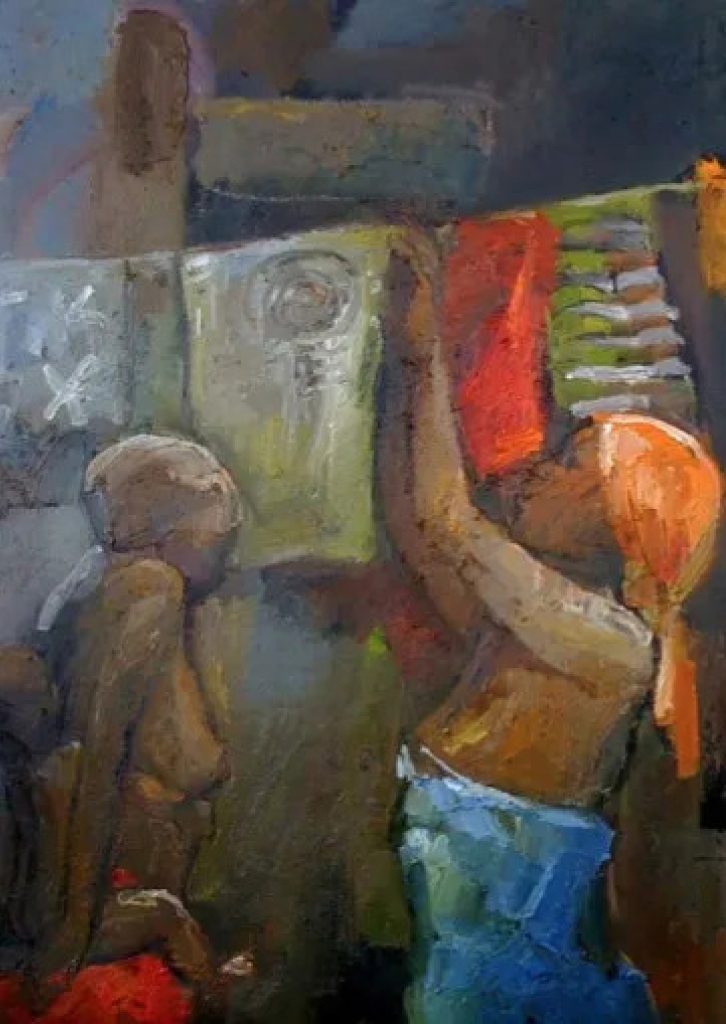
Kyeyune smiled when I told him the price of these paintings and said, “For us we are here sleeping.” His comment seemed apt, but not in the sense he intended it, because I said to him later that his work, his greatest work, even if it never fetches huge sums at auction, guarantees his immortality.
4.
One of Kyeyune’s last major commercial exhibitions was in 2011, with Afriart Gallery, when a number of his works were put up in a show titled The Kampala I will Always Come Back To. Many of the oil paintings were superb, and at least one is unforgettable: Gossip II, the picture of two women in conversation as one, hanging her washing on a clothesline, appears to utter something that makes the second woman flinch. The context is clear. And yet, reviewing the show in the online journal START, Angelo Kakande, a colleague of Kyeyune’s at Makerere University, wrote thus of the Gossip II:
She stiffens as if to avoid contact with the linen or the other woman in the space. The artist does not open any line of communication between the two. He however told me that the painting is about the effect of gossip. This reading is not clear unless if he meant that the two women are neighbours torn apart by feuds, rumours, gossip and envy, which are the kinds of vices common in Kampala.
One wonders what else Kakande wanted Kyeyune to do with his palette knife. To be fair to Kakande, he began his essay by acknowledging that his colleague had “mastered the skill and expressionist style” on display “by the time he was in the second year of his undergraduate programme.” But, in an ultimately ill-advised piece, he accused Kyeyune of sanitizing the Ugandan regime’s political failures:
In this article I show and argue that as representations of life in Kampala, Kyeyune’s paintings are not portraits of individuals or groups. They are in the first place art. In the second, they are sanitised versions of reality intended to suit middle class and tourist aesthetic tastes. In the third place, they carry the risks of pandering to state propaganda.
One wonders how the paintings can be art if they are not, as Kakande asserts, portraits of individuals or groups. If Kakande is to be believed, Kyeyune is a propagandist for the Kampala regime because he paints big-bummed women who go to the salon to have their nails painted or their hair done, because he depicts boda-boda men burdened by heavy loads in human flesh. Even now, if one ventures into the Kalerwe slum, it is possible to find a hungry woman with a lovely bosom, and, once the woman has been found, it is not of the National Resistance Movement that one thinks. The charges against Kyeyune were baseless, quite apart from the fact that they didn’t make sense.
By my lights no Ugandan artist at work today has been able to capture distinct versions of social reality the way Kyeyune has, and, in works evocative of our days, he remains a faithful chronicler of the thrills and troubles of Ugandans. It makes me sad to think that Gossip II is in someone else’s collection, for the joy such a painting gives (and the sense of wonder it arouses time and again) can never be exhausted in a lifetime.
There have also been those who find issue with what they think is the artist’s “habitual impasto technique,” as the critic Dominic Muwanguzi once wrote, reviewing a show at Makerere art gallery of Kyeyune’s work in 2022. Asking Kyeyune to paint another way is like telling Irma Stern in 1945 to drop the knife. Are you kidding? Impasto, an Italian word for “mixture,” generally refers to the application with a palette knife of thick layers of paint in a way that leaves the knife marks visible. Most artists paint with a brush, or with both brush and knife, but Kyeyune almost always paints with a knife.
Impasto is a convenient technique for an artist who is a sculptor first and foremost, but Kyeyune is able to create images that look like they were excavated from the canvas rather than painted over it. The paintings become rich with texture, a rare thing in contemporary art. With his knife Kyeyune succeeds in giving the woman in Mother Nature the powerful forlorn gaze that makes one think forever of what she was thinking that day, and in depicting the woman’s décolletage as though it is the thing that will remain if and when she loses everything else.
In the oil painting Abaana ba Kintu, a masterpiece that graced the cover of the fourth issue of The Weganda Review, the human figures emerge as if sculpted from the side of a mountain, alive and leering and somewhat disfigured by what they are plotting. These people are going nowhere, and if they somehow disappear there are others rushing forth to take their places. What Kyeyune shares with us in this and other magnificent paintings is the very picture of life, life as we know it, and we are so lucky to have him still at work. ▪
Cover image: Portrait of a Ugandan Woman (Mother Nature), 2021, oil on canvas, 60 x 53 cm