

Starting tomorrow, I will live a happy life. The first time I read this line I am sitting in a dingy prison cell, waving away flies that are stubbornly buzzing around the planes of my face. These flies buzz and keep buzzing until I let them do as they want. The guy to my right mumbles in tongues, his hands clasped as he prays with piety, asking the heavens that his judgment scheduled for the following day goes in his favor. He calls God, Jehovah, Emmanuel, Elohim numerous times in his prayer. He has been remanded here for three years, accused of robbery with violence. The one to my left has his shirt spread on his lap, eyes squinted as he picks and kills bugs from his yellow-striped black shirt, occasionally sucking his teeth.
I stretch my neck, tilting it from right to left, before lowering my head back to the poetry collection I am reading. It has a tattered spine and is coated with a layer of dust on its cover. The stamp impression on the cover reads: Luzira Maximum Security Prison Library. I am racing to finish it so that I can return it to the library before my next appearance in court, due in two days.
I read the line again: Starting tomorrow, I will live a happy life. I mouth the words while pondering their depth. I think of how happiness is rare in this place. My head plays back the events that led me here. “How unfair can life be?” a voice in my head grunts. Starting tomorrow, I will live a happy life: I read the line again. And again, each time inscribing it into the fold of my smarting heart. I don’t proceed to the subsequent lines. I will not be able to do so for weeks afterwards, at least not until I leave this place.
My arrest was somewhat a joke. Afande Alex had phoned me twice, the first call going unanswered because I was at the American Center Library in Kabalagala, concentrating on Toni Morrison’s Jazz. Later, after I saw the missed call, I neglected calling back. Since moving to Uganda, I barely ‘loaded airtime’ for direct phone calls. My airtime was only for the purpose of subscribing to internet data. The calls I made were either on WhatsApp or imo. Afande Alex’s second call came the following morning while I was still in bed, scrolling through my YouTube, downloading videos to watch later. I wondered if this was an attendant from any of the few places I had sent job applications now calling to invite me for an interview. I picked up.
“Hello, is this Mohan?” the soprano voice asked from the other end. I lifted myself from my bed and sat still.
“Yes, this is Mohan.”
“My name is Alex and I have received a complaint against you. The complaint is on defamation.”
His words didn’t move me. If anything, I was so certain of my innocence that when he asked me to go to Wandegeya Police Station to record a statement, I readily agreed.
“I have looked at the message and I don’t see any defamation. Just come and record a statement, then we will handle it from there.”
I immediately left my room, still draped in my pajamas and crocs, got a boda-boda and rode to Wandegeya Police Station. Never did I think that I would end up being locked in jail. Naively, I had fallen into a trap.
While being held at the police station, I thought of how in the two months that I had worked for a certain Mr. Charles I had seen him inappropriately touch my female colleagues. How he pressed himself on their behinds, seemingly not restrained by the guilt of others watching. I should have spoken up then. His inappropriate touches went on until the day Tina walked back to our open office from his, her eyes red. Her chest was heaving, and it was clear she had been crying. All the four of us, her colleagues, silently looked at her as she packed her stuff from her desk. Before storming out, Tina, tears pearling on her face, whimpered over her snorts: He pushed me to the wall, put his filthy hands on my breasts, almost raped me.
Our silence deepened. My mouth went round in astonishment. I tried to visualize Mr. Charles’s nasty body exacting its force on Tina. I felt disgusted. And as she left that day, quitting her job, I also made up my mind to act in solidarity with her. I was going to quit.
That evening, as I walked back to my place, I drafted a message. The message that would later be the basis of Mr. Alex’s defamation claim against me.
I read the draft twice. Copied it. Pasted it. Despite suspecting that Mr. Charles knew ‘important people’ and was vengeful, I dropped my words into a WhatsApp group in which people who knew him could now know of the terrible things he was capable of. I switched off my phone and, instead of going to my place, walked to a local joint in Kansanga to have a drink. I had to drink away my stress, drink in my new reality, which was that of being jobless. At midnight I left the joint. I staggered to my place, passed out as soon as I got in. When I turned on my phone the following morning, it could not stop buzzing. All my former workmates had tried reaching me, some dropping messages acknowledging my boldness, others exclaiming at what they thought would come next.
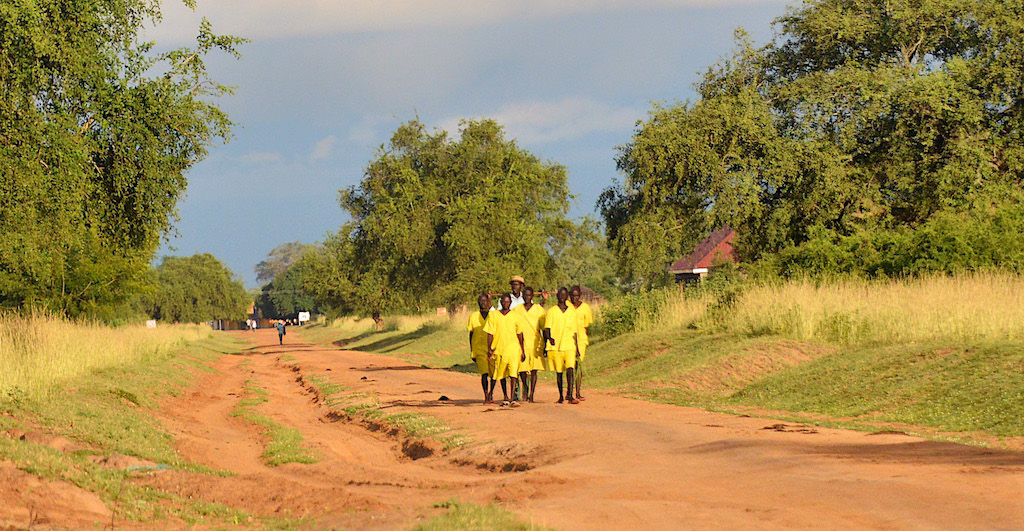
This was a week before Afande Alex called.
In Wandegeya, held in police custody, I pleaded for my phone, asking if they could let me make a call. My fright was complex: as a Kenyan, with no family in Uganda, I felt I could be disappeared and my people back home would not know where to start looking. I wasn’t allowed to make a call. On the third day, I was among those being taken to court. My pajamas were soiled from sleeping on the floor. Imagine stepping into the dock in your pajamas? I had never imagined this happening to me. They shackled us in two groups. The officers leading us to the courtroom commanded that we squat so that they would take a roll call. Chuchuma was the word for squat. I obliged. We all had to oblige.
Standing up against a sexual predator had brought me to this.
In the courtroom a tall, soft-spoken magistrate asked whether I was guilty or not. I helplessly went on a rant, trying to explain my situation. “Come back on 13th of next month and we will hear you,” she said. The ‘13th of next month’ was three weeks and four days in the future. How was I going to survive gory conditions in a maximum-security prison? What would I eat? On what would I sleep? I was in disarray as I dragged my feet back to the holding cell, waiting for the rest to finish their court sessions before we rode back together to jail. This was a wild dream that had a coarse texture.
At the time of my arrest, I wore a long beard that I hadn’t shaved in four years. I hadn’t cut my hair in two years. The untrimmed beard and unshaven hair had become almost part of my character, so to speak. They were part of my charm as a creative. These ragged looks were a way of living free, breaking conventional bounds.
This changes the evening I arrive in prison. The warden reaches for a rusted razor blade from between the pages of a register book pressed under his arm. He blows away speckles of hair from the blade and begins pulling the tufts of my hair, cutting them one by one, whistling a tune whose melody is familiar. The tune is Mama Rhoda by Chameleone. I wince at how calloused the warden’s hands are. He turns my head aggressively while pressing on the scruff of my neck. I want to hurl insults at him. I hold my words. I breathe in, then exhale. You will survive this, the voice in my head mutters. I can hear how tremulous that voice is. My teeth chatter. I am frightened.
While still captured by my own thoughts a whipping sound slices the air. We, the new inmates, see one of us receiving lashes. He has been found with a stub of weed stuck between his buttocks. We smirk. Deep down, we know that we are laughing to only stop ourselves from crying.
This is my welcome to Luzira, a place that will be my home for the next two months.
We sleep on the bare floor. The frigid coldness emanating from the floor doesn’t eat our bodies. We are supposed to shiver. We don’t. Our bodies are packed. Spaces are limited. Every evening the ward leaders arrange us like sacks. We are like objects and they toss us about. One fart and the murky, crowded air we share decays. Sweat blooms from under our arms, from our nose bridges, and even from our behinds. But we survive. Our survival is in how we gather, most of us with our ‘prison-made’ calendars, counting days to our next courtroom appearances. Those already sentenced count months or years already spent. We feign smiles, cry soundlessly. Our tears flow back to our stomachs and our only comfort is in the assurance that someday we shall find freedom, if that day finds us alive.
The morning after I am released on bail I lay in my bed, intentionally lazing. I reach for my phone, which still feels unfamiliar in my hand. Its weight is not the same – at least it doesn’t weigh as much as I remember it weighing before I was sent to prison. I turn on my data, then in my Google search engine I put in the line I last read in prison: Starting tomorrow, I will live a happy life. I scroll down, searching for the whole poem.
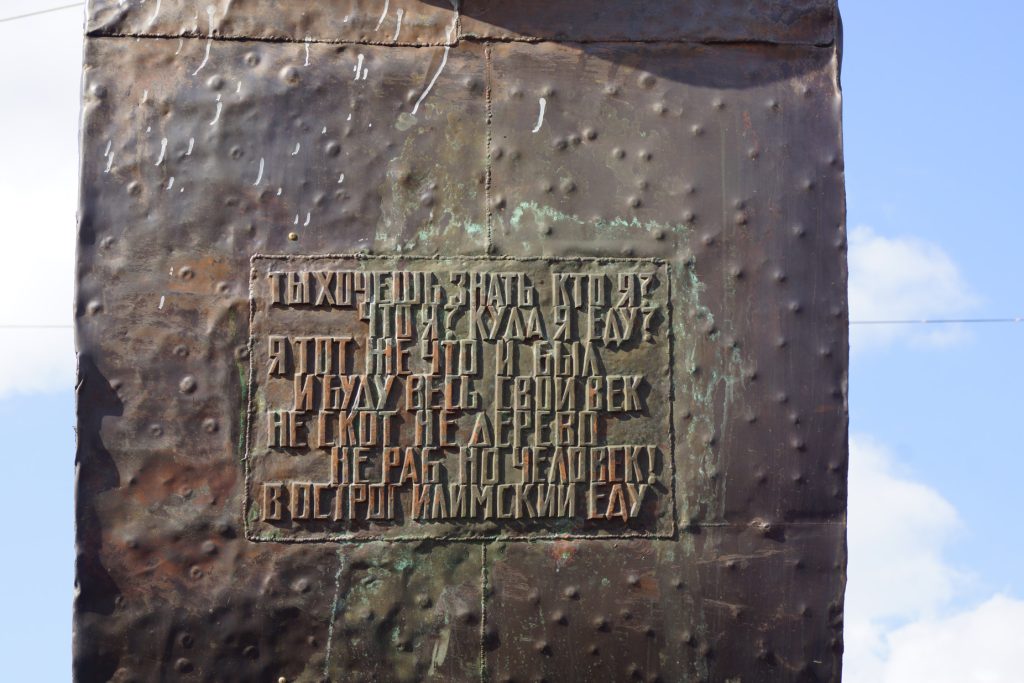
A memorial sign to the Russian poet Alexander Radishchev, Vasily Astanin, CC BY-SA 4.0, via Wikimedia Commons.
I learn that the poem whose line had consoled me while in prison was written by a poet named Hai Zi, sometimes spelt as Haizi. I search for more about him. I look into his life so much that you would think I want to bring him back to life. On my notebook app, I write down notes, mostly questions around why Haizi would write such a poem and then go on to die by his own hand.
What was in tomorrow that would make him happy?
What was the value of happiness in his life?
How sure was he that tomorrow would come? And that it would bring him happiness?
After exhausting all I can find about him, my heart palpitates with doom similar, perhaps, to what Haizi felt some days: a desire to die. I close the Google tab.
Still on my bed, I feel bugs exploring my pubic hair. I must have brought these agents from the maximum-security prison. I am transported back. Now I imagine the guy to my right saying a prayer. I go in and out of naps, dreaming of sweat falling from the spirals of the ceiling board. I hear the guards calling us to attention for our morning roll call, their guttural voices commanding us to chuchuma. I hear the soles of their boots and my eardrums cringe. Nausea rises in my throat, food from yesternight comes back to my mouth. I vomit. My nerves are parched. I am still afraid even after being released. It feels like I am deluded. My fury awakens, pushing me to punch my pillow. Tears fall from the corners of my eyes. All I want is justice. ▪