

If you are fortunate enough to avoid the nuisance of youth and haven’t seen a working teenager in so long you cannot remember what one looks like, let me tell you: they often appear, despite the best efforts of our legal system, in our bars here in Kampala, the city where I live and drink.
They are odd-looking creatures — at least they look odd in bars, giggling and squealing in badly balanced second-hand wigs, or, seeing as they have discovered effective gender now, gangly and uncoordinated, with limbs as clumsy as their breaking voices.
They look like what they are: beings trying unsuccessfully to disguise themselves as adults.
If this sounds petty and mean and cruel, I should point out that I am fifty years old. Men my age don’t like teenagers in bars; it lowers the bar. The legal drinking age is twenty-one, but those kids are not welcome until they are at least twenty-nine.
Now that I have opened with such a comprehensive image of what a teenager is, let us proceed.
Picture this: You are in the middle of a battlefield. The enemy is fierce, fearless, furious. The warriors have long machetes, sharp and heavy, which can, and do, lop heads off with one swing.
The warriors keep advancing and decapitating, unrelenting and merciless. There is an unstoppable wave of deaths — fast, forceful, final deaths. You are doomed.
And when they finally descend upon you, looming dark, you see the face of the one who is going to kill you.
And it is the teenage girl from the bar!
That was what flashed through my mind when I first heard of Seh-Dong-Hong-Beh of the Dahomey Mino.
She was the general of the 6,000-strong Mino military company. They were an all-female battalion notorious in 19th century West Africa for their courage and ferocity.
There is a colorful picture of General Seh-Dong-Hong-Beh, drawn in 1851 by a certain Frederick Forbes, carrying a human head the way we carry handbags.
Yes, I said we. I carry a handbag sometimes. What? Are you going to make a big deal of it? I need a place to put my cellphone, notebooks, and pencils. I cannot carry a backpack because, as I said, I am fifty years old and I have fifty-year-old back things. The vertebrae don’t hold up as well as they used to and the slightest strain will make one or two give up. And I can’t use my pockets because they are full of money. So it has to be a handbag.
I would have paused before telling you that I am a man with a handbag but Seh-Dong-Hong-Beh’s mere existence, even if it was so long ago, effectively rendered any preconceptions and supposed gender restrictions silly. None of them can stand up to the sheer force of her legacy. I cannot be embarrassed into hurting my back by the perception that I am doing women things. Not after Seh-Dong-Hong-Beh decapitated all those men in the 19th century.
If you would like to know, I hold the bag like a severed head.
Seh-Dong-Hong-Beh led the Mino (also known as the Agojie) in the 1850s, when she was probably still a teenager. She had been conscripted at ten and by the time she began her ascent to a general’s rank the Mino were established as the king’s elite guard, having elevated themselves far above their origins as his elephant hunters.
The Mino started as a group of elephant hunters called the Gbeto. King Wegbaja of Dahomey had a corps of girls chosen, trained and equipped with elephant-hunting expertise, and they did a great job. The court of Dahomey took this thought further: if the girls could kill elephants so well, what else could they kill?
Again girls were chosen, trained and equipped, this time to wage war for the king. And that is how the Gbeto became the Mino.
The Mino cut heads off. They didn’t leave their opponents with heads.
There is a long and gushing report by Frederick Forbes, the aforementioned artist, written after his encounter with the leader of the Mino.
But this is what I think he saw.
Imagine you are in the audience of a grand sports arena for a special royal event. There is King Ghezo of Dahomey, looking pleased with himself, flanked by his adoring coterie of professional king-adorers. Every king has some. The more of a king he is, the more adept the adoration.
This king is also accompanied by a meek and nervous-looking white man, Forbes, who takes notes as the spectacle below him unfolds.
The scene is a mock battle where the king’s elite guard force – his SAS, his Delta Force, his Navy Seals, his Rambos – are going to show how dangerous they are.
And behold, do they show danger! They storm a barricade of thorns and brambles, ignoring the stings and stabbings like, “What, this? I eat worse thorns for breakfast, then belch nails and burp arrowheads. These thorns are not even an insult. I regard them with as much concern as I give houseflies on my hair. Shut up, I’m busy fetching the enemy’s head.”
The enemy is lucky that this is just a demonstration because, by the time the warriors descend from the barricade of thorns and find him, they swing their machetes with skill and intent that ought to decapitate in one attempt.
The enemy is lucky because this is just a demonstration and the victim is just a model – a scarecrow, not a real person. The real people’s heads were all cut off a few months before, during the last battle, when the Mino slaughtered and slayed their latest group of victims.
They cut heads off. They didn’t leave their opponents with heads.
At the end of the demonstration the general of the Mino holds the scarecrow head up and recites a speech declaring loyalty to the king, promising more decapitations and offering the assurance of how much more dangerous the violence can be than this little display suggests.
And the general, Forbes reports in rapt awe, is young Seh-Dong-Hong-Beh.
One of the better-documented tales of General Seh-Dong-Hong-Beh’s martial exploits is the attack on Abeokuta. Before it became the scenic, vibrant Nigerian city that it is now, back in the 19th century Abeokuta was a fortress refugee community of stragglers from different slave-raiding sites around the region.
Back then, life in smaller, weaker, lesser-armed villages was precarious. One day you would be out living a normal life: pounding your nuts, milking your cattle, weeding your farm, committing sneaky adultery with the deputy chief’s wife, or smacking your kid because he has gone too far this time, and you have told him again and again and again and again but his head is like a leather toy.
So, one day you are doing your thing in a small village and then suddenly: a crack of thunder, a flash of lightning, the scream of wild birds, and your village is full of these evil things with machetes and swords. Your son, who, during his whipping, was secretly praying that someone does the same to you, is aghast to see a mob of war-painted warriors kick, slap and bludgeon his dad. The worst form of coitus interruptus occurs in the bushes behind the deputy chief’s house when a bullet from a musket plunges into the bare buttock that had, just at the fateful moment, been recoiling for a deeper thrust. The sky is blacked out by a thick cloud of flying arrows and spears, and the ground is drenched in blood.
How long does a village slave raid take? I don’t know, but I think it is safe to assume that it takes too long because no tragedy finishes too soon. The peaceful, simple, calm life is gone. Embers, smoke, and a thick litter of dead friends and loved ones are all that remain when you look back.
You get one look because the invaders are now captors. They are taking you away. They have you tied up and are marching you away from your home. You are going to march in chains and ropes all the way from here to the coast, where you will be loaded into the darkness of a giant boat and carried off to a hell you can’t yet even imagine, not even in your most gruesome nightmares.
Your simple village life is over now. You are now less than human. You are now property, you are now livestock, you are now a commodity. You are a slave.
That is what made Abeokuta. The kingdoms of Dahomey, Oyo and others carried out frequent slave raids to gather people that they could then take to the coast to sell to the slave-buying savages waiting there.
Can I take a moment here to really beat that comment in? Slave buyers, the white man at the coast waiting to ship his cargo of hapless Blacks to the Americas and the West Indies, the one who justified his choice of trade by claiming that Black Africans were just savages anyway and it was okay to buy and sell them like sneakers and mobile phones, that white man was a savage himself. You are a savage, you racist white man, you transatlantic trade merchant.
Except, of course, that the coin of this commerce has two sides: If it is savage to buy and own slaves, is it not savage to sell them?
Human life. It’s the same everywhere, and no single race is different enough from another to be superior or inferior. They bought slaves, we sold them. We are all savages.
Or maybe we are not. The opposite of savage is what? Civilized?
Civilization, whether that of the Greeks or the Abyssinians, aims to discover ways of making things that make things better. Nowadays they call that technology. It goes hand in hand with finding people who have the things you need to make your things better and then making them give you those things. This is called trade. In the end you have a civilization, a place where you have a complex and intricate system of having the things that you need no matter whether you bought them or made them.
But another very common way of getting the things you need is, of course, to just take them: not through trade but by force. That is the reason why the strongest civilizations have strong armies — civilization goes hand in hand with empire-building and empire-building is done by force of war. And every war has dehumanized its captives, turned them into slaves, if not in the dictionary sense then in some other cruel way that denied their humanity.
So that is how Abeokuta came to be. Refugees from slave raiders and slave hunters fled to a large rock outcrop, and, taking advantage of the shelter it offered, built a community there to keep themselves safe.
This community grew and became more integrated, strong and self-reliant until it was far more than just a refugee encampment. It became a formidable town on its own.
One day in 1851 the Mino attacked Abeokuta.
Picture this: There you are, living a sedate, normal, urban life in Abeokuta, looking for a job, looking for a girlfriend, playing your sports, running a passive-aggressive long-term quarrel with your parents over milk, of all things, or maybe trying to find a way to domesticate and train snakes to slither deep into your gutters to find and eat the frogs that have begun to breed in there because their nighttime croaking is driving you crazy. You are living a simple life when the alarms go off. The Mino are coming.
Seh-Dong-Hong-Beh and a blazing firestorm of 5,999 Mino are approaching Abeokuta. Their mission is to get those slaves.
The rocks were effective in providing cover, defense and refuge from attacks, and they allowed the people of Abeokuta to grow powerful enough to protect themselves, so that their counterattack of 10,000 better-armed soldiers, fighting on home ground, repelled the Mino.
Stories from the battle scene tell of almost manic bravery on the part of Seh-Dong-Hong-Beh and her army. They ignored wounds and pain as if those were light tickles from petals and feathers and kept fighting until they were struck down dead. But courage isn’t what wins wars; strength does. And the Mino were outnumbered and outclassed. It is believed that it was during this war that Seh-Dong-Hong-Beh was killed.
She was probably eighteen and had spent half of her young life as a soldier.
And she was a dead soldier before she could even become an adult.
Remember the teenager at the bar? Come with me and let’s go back to the bar ten years forward and see the same girl there. Now she fits the scene. She has a fitting tailored business suit and a laptop bag slung over the back of the barstool. Her iPhone and car keys lie next to the circle of water left by the glass she has lifted to her mouth as she laughs and jokes with her friend, an identically mature and self-assured twenty-eight-year-old. They both hold their cocktails with the casual assurance you get when you own the cocktail — not just having bought the contents of that particular glass, but having consumed, enjoyed and loved that recipe for so long that it is now your drink, in the sense of that I’ll have the usual way a drink becomes yours.
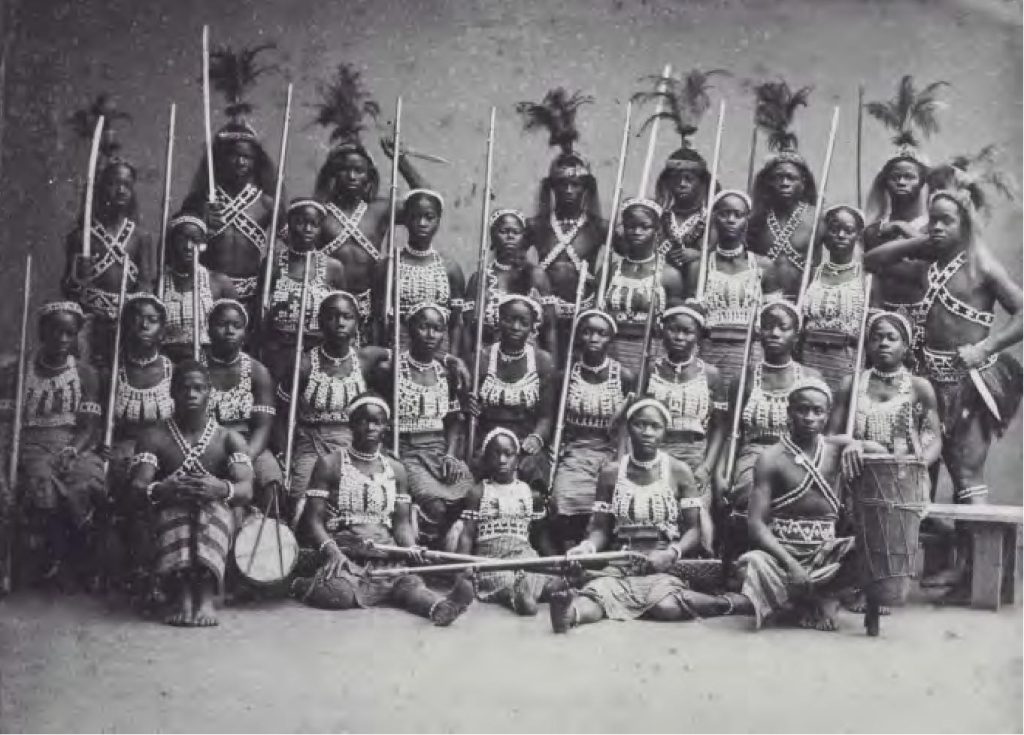
A group photo of some of the Dahomey Mino touring Europe in 1891, via Wikimedia Commons.
When some guy walks up to try his luck with her, she barely breaks her conversational stride:
She was saying, “It’s an appreciating asset, yeah? There is no gamble to it, no risk, it’s a sure thing. I get that. But that is where the problem is.” She takes a small sip and places the glass down. “I kind of find that, I don’t know, boring? Can I say boring? I know it is the wise thing to do but I like a sense of adven…”
The man at her shoulder coughs and begins, “Hi. Excuse me, I don’t mean to interrupt, but I just saw you from across the room and I had…”
She only slightly turns her head. “Dude, I am in the middle of a conversation with my friend here? I’m sure you’re a nice guy and everything but, not now, okay. No offense.” Then smoothly, in the same stride, she returns to the conversation, “I like a sense of adventure. The rush from taking the risk, you know? If I wanted to play the safe bets, I would go into government, but then I wouldn’t be me. I am a fighter, sis. I love the smell of blood in the air…”
Yes. Those teenagers – the energy that makes them seem annoying also makes them grow up into powerful young women who then grow into powerful old women. If it doesn’t destroy them first.
Seh-Dong-Hong-Beh never got to be a young woman, nor an old one.
It seems at first as if her story is an uplifting one of the greatness and glory of pre-colonial Africa, an example of how we were foresighted enough to not bow to the sexism that held down the rest of the world’s women.
But Seh-Dong-Hong-Beh was a child transformed into the part of a brutal tool of death and enslavement. Child soldiers in modern times are lied to, drugged, brainwashed and exploited until they become monsters. It is apparently not a new thing.
Seh-Dong-Hong-Beh: What does her story tell us about ourselves? That our ancestors were just like us. Kings and chiefs conspired with the capitalists offshore to play their people for chumps, turned brother against brother, sister against sister, and daughter against all, for their own aggrandizement, for the wealth of the slave seller as much as the buyer.
The more things change, the more they stay the same. ▪
Cover image: Seh-Dong-Hong-Beh as depicted in an 1851 drawing by Frederick Forbes, via Wikimedia Commons.